
1. Juni 2026
How to Get Into a German University or the LSE with British A-Levels: Admission Requirements Explained
Choosing between a German university and the London School of Economics is not simply a question of preference — it is a question of preparation. Both pathways are genuinely open to internationally-educated students, but each operates on a distinct set of rules: different qualification frameworks, different language thresholds, different financial requirements, and different ideas of what "competitive" means.
This guide sets out exactly what you need to know, whether you are holding A-Level results or still in the middle of your sixth-form studies.
Germany or the LSE? Understanding the Two Systems
Before anything else, it helps to understand the fundamental difference in how each destination thinks about admission.
German universities — particularly public institutions — operate on a qualification-based model. If your secondary school certificate meets the formal requirements, you are eligible to apply. The process is largely procedural, built around verified documents, classification databases, and language exams. There is less subjectivity; there is also less room for a compelling personal statement to compensate for a borderline grade profile.
The LSE operates on a competition-based model. Meeting the grade offer is necessary but not sufficient. The institution received roughly 30,000 applications for approximately 1,900 undergraduate places in 2025. Holistic review — personal statements, references, contextual data, and in some programmes dedicated admissions tests — is central to how decisions are made.
Neither system is more or less demanding. They are demanding in different ways, and preparation must be calibrated accordingly.
Part One: German University Admissions
The anabin Database: Where Everything Starts
Every German university and every German embassy visa office uses the anabin database, maintained by the Central Office for Foreign Education (ZAB). Its purpose is to classify foreign secondary school certificates according to their equivalence to the German Abitur — and the outcome of that classification determines your entire admissions pathway.
There are three possible results:
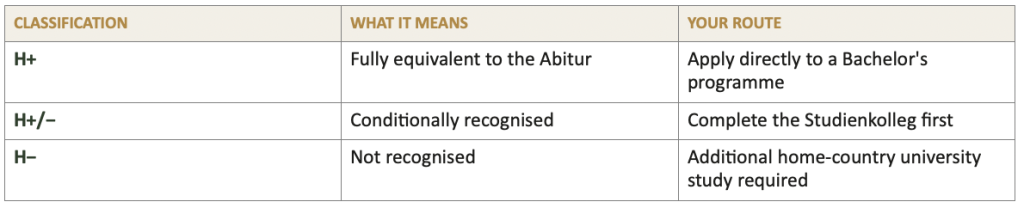
There is also an important distinction between Allgemein access, which permits study in any subject field, and Fachgebunden access, which restricts you to fields that match your secondary school profile. This matters particularly if your A-Level subject choices do not align naturally with your intended degree.
One practical note: completing one to three semesters at a recognised university in your home country can often upgrade conditional H+/− recognition to full H+ recognition.
What Is the Studienkolleg?
If your qualification is classified H+/−, you will be required to complete the Studienkolleg before beginning your degree. This is a two-semester bridging programme designed to bring international students up to the academic standards expected at German universities. It is not a generic preparation course — students select a subject-specific track based on what they intend to study.
- The T-Kurs covers Engineering, IT, Mathematics, and Natural Sciences.
- The M-Kurs covers Medicine, Biology, and Pharmacy.
- The W-Kurs covers Business, Economics, and Social Sciences.
- The G-Kurs covers Humanities, Arts, and Political Science.
- The S-Kurs covers Languages and Cultural Studies.
The programme culminates in the Feststellungsprüfung (FSP), a comprehensive final examination whose result is valid at universities across all 16 German federal states.
There is one additional route for H+/− students: sitting the TestAS (Test for Academic Studies). A sufficiently strong result may allow applicants to bypass the Studienkolleg at specific participating universities — though it has no effect on language requirements.
The Numerus Clausus
For programmes with restricted places — most notably Medicine, Psychology, and Dentistry — admission depends on the Numerus Clausus, a grade-point threshold below which applicants are not considered regardless of other qualities.
This is where the Modified Bavarian Formula becomes important. Used by TU Munich and several other institutions, it converts a foreign grade into the German 1.0–4.0 scale using three inputs: the maximum grade possible in your home system, the minimum passing grade, and your own result. For letter-grade systems, numerical equivalents must be assigned before the formula can be applied.
Understanding where your grades sit on the German scale — and how that compares to the NC threshold for your intended programme — is essential preparation to complete early.
German Language Requirements
For German-taught programmes, C1-level proficiency is a formal requirement for enrolment, not an aspiration. Three examinations are widely accepted:

For students considering English-taught programmes at German universities, German language requirements are waived — but standardised English test scores (IELTS or equivalent) are required instead.
Part Two: LSE Admissions
Grade Offers Are a Starting Point, Not a Finish Line
The LSE publishes typical A-Level offers of A*AA or AAA for most undergraduate programmes. These figures are widely cited and genuinely important — but they require context.
In a cycle where 30,000 applicants compete for 1,900 places, a high proportion of those applicants will already meet the grade threshold on paper. The LSE's admissions process reviews personal statements, academic references, and contextual data alongside predicted and achieved grades. Preparing for the LSE means thinking carefully about the entire application, not just the A-Level profile.
Programme-Specific Admissions Tests
Three programmes at the LSE require dedicated admissions assessments, and preparation for these should begin well before the application deadline.
LNAT — Law National Admissions Test
Mandatory for all LLB applicants. The LNAT consists of a multiple-choice comprehension section and a written essay. It is designed to assess aptitude for legal reasoning rather than prior legal knowledge, and a strong result is a meaningful differentiator in an exceptionally competitive pool.
TMUA — Test of Mathematics for University Admission
Mandatory for BSc Economics and BSc Econometrics and Mathematical Economics. The TMUA tests mathematical reasoning and the application of mathematical knowledge — not simply procedural calculation. It is also recommended, though not required, for other quantitative degrees at the LSE and at other universities.
UGAA — Undergraduate Admissions Assessment
Used for applicants presenting non-traditional or less common qualifications, to assess English literacy and mathematical competency. If your qualification falls outside the mainstream framework, check whether this assessment applies to you.
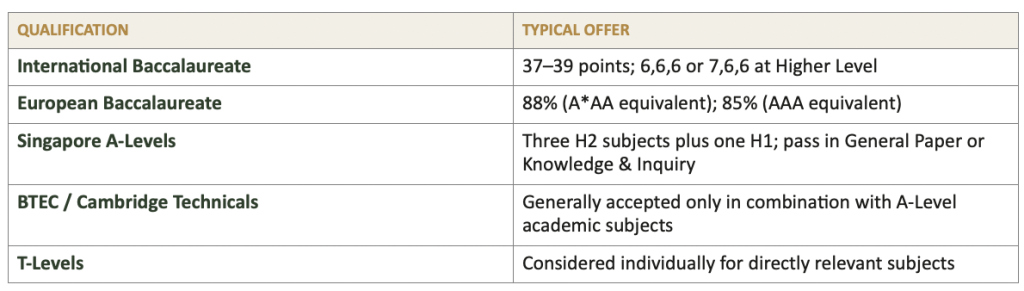
International Qualifications the LSE Accepts
The LSE considers a wide range of credentials alongside UK A-Levels.
English Language Requirements
Applicants for whom English is not a first language must provide formal evidence of proficiency. The LSE typically requests this documentation after a conditional offer is made — but the requirement should be factored into your planning from the outset.
Part Three: Financial Planning
Germany — The Blocked Account
International students applying for a German student visa must demonstrate financial self-sufficiency. The mechanism is the Sperrkonto — a blocked bank account with a government-mandated minimum deposit.
The current required amount is €11,904 for the first year of study, released at €992 per month as a living expenses allowance. This provision covers living costs only. Tuition at German public universities is either absent or nominal — a semester contribution of €100 to €400 is typical. Private institutions charge significantly more, ranging from €5,000 to over €20,000 per year.
For most internationally-minded students, Germany's combination of tuition-free public university education and the structured Sperrkonto system represents a comparatively accessible financial model — provided the living cost requirements are understood and planned for well in advance.
The LSE — London Costs
The LSE sits at the opposite end of the cost spectrum. Postgraduate tuition for the MiM programme in 2026–27 stands at £42,900, and London living costs run to approximately £1,400–£1,600 per month. The total annual financial commitment is in the range of £57,000 to £60,000.
Need-based financial support is available through the LSE's Graduate Support Scheme, which awards between £5,000 and £15,000 to eligible students. Researching and applying for aid early — ideally before or alongside submitting the main application — is strongly advisable.
Application Logistics: Uni-Assist and the VPD
For German universities, international applications are commonly processed through Uni-Assist, a centralised evaluation service. Before any admission decision is made, applicants must obtain a VPD (Vorprüfungsdokumentation) — a standardised document that summarises how your foreign grades compare to German academic standards.
The VPD is not an admission offer; it is a mandatory procedural step without which most German universities will not process your application. Processing typically takes four to six weeks, and significantly longer during the peak season between May and July. The fee is €75 for the first application and €30 for each additional university in the same semester.
Plan for the VPD well in advance. Missing the processing window can delay your application by a full admissions cycle.
The White Oak Perspective
Both pathways — a well-chosen German university and the LSE — reward students who understand the system they are applying to. The students who struggle are not always those with the weakest academic profiles; they are often those who underestimated the procedural complexity, left language certification too late, or arrived at the application stage without a considered narrative.
At White Oak College, our small seminar classes and individual academic mentoring are designed precisely for this kind of ambitious, internationally-minded student — one who wants to understand not just the content of their A-Level subjects, but the landscape they are entering.
If you would like to discuss how our programme supports pathways to German universities or the LSE, we would welcome the conversation.
Contact our admissions team: admissions@whiteoakcollege.org
White Oak College is a registered sixth form based in England and Wales, offering Pearson Edexcel International A-Levels in small seminar classes. We support university pathways to the UK, Germany, and across Europe.